Emerald Ash Borer Has Reached Douglas County: What Parker and Castle Rock Homeowners Need to Know
In early August 2026, Colorado State University confirmed emerald ash borer (EAB) in Parker, the first detection in Douglas County. If you have an ash tree in Parker, Castle Rock, Castle Pines, or anywhere nearby, this is a good moment to learn what it means for your property and what your options are.
There is no reason to panic. There is also no reason to wait and hope. Here is what we know, how to check your own trees, and how we would approach protecting them.
What Was Found in Parker
A certified arborist was called to a Parker home where the ash tree in the front yard looked unhealthy. After peeling back bark and checking the D-shaped exit holes, he found an adult emerald ash borer and sent it to CSU, where entomologists confirmed the species. The tree is on the north end of Parker, and signs of the beetle were showing up on other ash trees in the surrounding yards.
The Town of Parker's forester had already set traps because he suspected the beetle was in town. Now that it is confirmed, the town is mapping how far it has spread through nearby neighborhoods and treating ash trees in town parks. It is also likely the beetle has been in the area for some time before anyone found it.
For context, EAB was first found in Colorado in Boulder in 2013 and has now reached at least 29 Front Range communities. Parker was one of four new cities confirmed this year, along with Firestone, Ken Caryl, and Colorado Springs.
Why This Matters for Douglas County Homeowners
Emerald ash borer is a small metallic green beetle, smaller than a penny. The larvae tunnel beneath the bark and cut off the tree's ability to move water and nutrients. Ash trees have no natural defenses against it, so it attacks healthy trees just as readily as weak ones. Stressed trees, including those dealing with drought, tend to be even more attractive to the beetle.
Ash trees were a popular landscaping choice in the 1990s, which means many established Douglas County yards have at least one. Without treatment, an infested ash typically begins to die within three to five years, according to university research, and by the time damage is visible from the ground, the infestation is often well along.
It is also worth understanding how EAB differs from the mountain pine beetle many of us in Castle Rock and Castle Pines know well. Pine beetles mainly go after trees that are already stressed or declining. EAB does not wait for a tree to be weak. A perfectly healthy ash is not protected just because it looks strong.
Is Your Ash Tree at Risk?
How to tell if you have an ash tree:
Compound leaves with 5 to 11 leaflets arranged opposite each other on the branch
Buds and branches growing directly across from one another, never staggered
Grayish brown bark with diamond shaped ridges on mature trees
Signs of an active infestation:
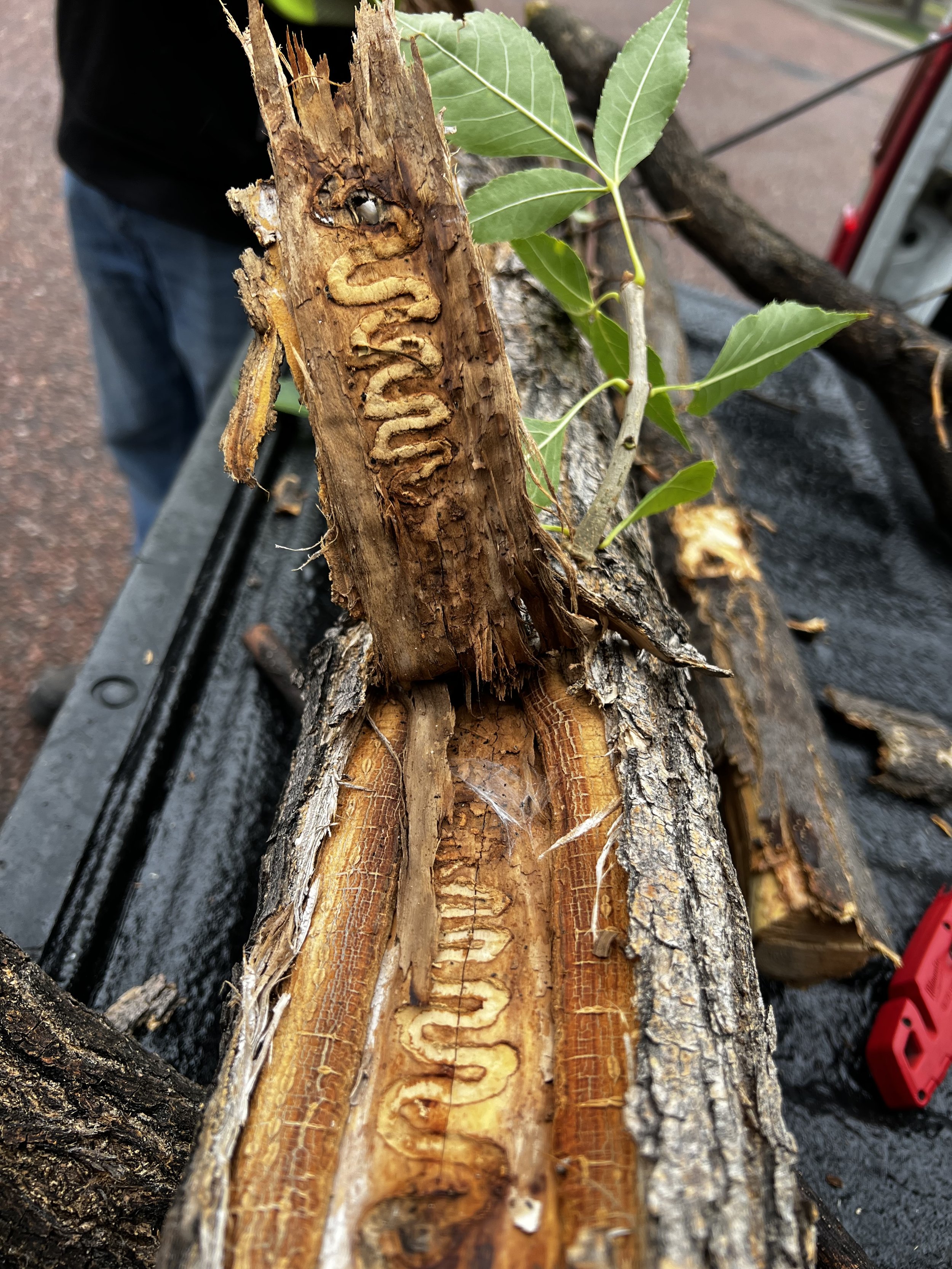
S-shaped tunnels beneath peeling or damaged bark
Small, D-shaped exit holes in the trunk or branches
Thinning canopy or dieback starting at the top of the tree
Unusual sprouts growing near the base of the trunk
Increased woodpecker activity, since birds feed on the larvae underneath
Because EAB starts high in the canopy and works its way down, the first signs are easy to miss from the ground. Our climbing crews watch for them on every job, not just on ash tree visits.
One note of caution: a metallic green beetle on your property does not automatically mean EAB. The green flathead borer looks similar but does not attack living trees. That is why a professional identification matters before you assume the worst.
Treatment Options for Ash Trees
For healthy ash trees, or trees in the early stages of infestation, treatment can work. We offer three options, in the order we generally recommend them.
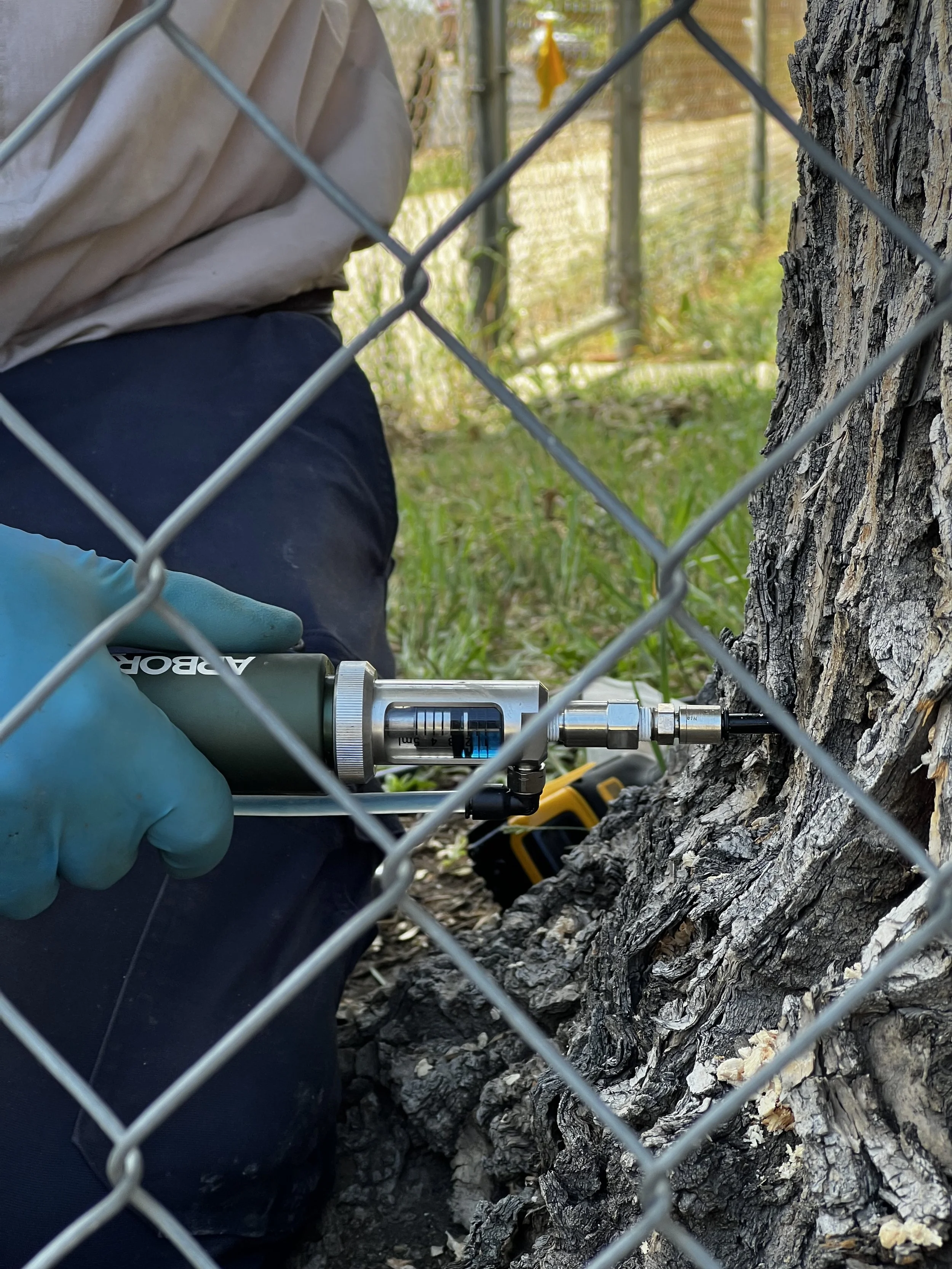
Trunk injection: Our first choice for most established ash trees. A small amount of product is injected at the base of the trunk, and the tree carries it up through its vascular system. Beetles that feed on the tree are stopped before the larvae can do damage. University research has found it to be the strongest performer against EAB, and it is also the approach Parker's town forester is using on ash trees in town parks. Protection generally lasts about two years per application.
Basal bark spray: Applied to the lower trunk, where it is absorbed quickly and moves through the tree faster than a soil treatment. A solid middle option when trunk injection is not the right fit.
Soil applied treatment: Absorbed through the root system. This is our last resort option, since research shows it is less consistent on larger trees, roughly 12 inches in trunk diameter or more. It still has a place for smaller ash trees or as part of a broader property plan.
Which option fits your tree depends on trunk diameter, canopy health, and how the tree is positioned on your property. That is what our free assessment is for.
Treat or Remove?
Trees with roughly 30% or less canopy loss are often still good candidates for treatment. Trees in serious decline are usually beyond saving, and an infested tree left standing becomes a place for the beetle to multiply and spread to neighboring ash trees. If a tree is heavily infested, removing it sooner is better than letting it go through another growing season.
There is also a safety side to waiting. Once a tree has lost around a large part of its canopy, it generally is no longer safe to remove with climbers and needs different equipment, which could raise the cost on removal. We will tell you when treatment makes sense and when removal is the more responsible call.
Why We Plan Treatment for Early Spring
If you have a healthy ash tree, the best window for treatment is early spring. That means fall is the right time to get your tree assessed, find out what condition it is in, and get on the schedule, so you are covered when the timing is right and not scrambling later.
Trees that are already seriously declining are different. Those are worth looking at now, since the cooler months are a sensible time for removal and the adult beetles are not actively flying.
What to Do Now
Find out if you have an ash tree. Check the leaf and bark clues above. If you are unsure, we are happy to identify it for you.
Look at the canopy. Thinning or dead branches at the top of the tree are the most common early sign.
Get a professional assessment. A certified arborist can confirm what is going on far better than a single hole in the bark can.
Plan treatment for healthy trees. Early spring is the target, so assessments and scheduling now make sense.
Do not move ash firewood or logs. EAB spreads fastest when infested wood travels. If an infested ash is removed, keep the wood local and have a professional handle disposal.
Frequently Asked Questions:
-
The first confirmed detection in Douglas County was in Parker, announced in early August. The beetle flies and also travels in moved firewood, so it is reasonable for nearby communities like Castle Rock and Castle Pines to plan ahead. The Colorado State Forest Service tracks confirmed locations if you want the latest map.
-
Look for compound leaves with 5 to 11 leaflets arranged opposite each other, branches that grow directly across from one another, and grayish brown bark with diamond shaped ridges on mature trees. If you are not sure, we will identify it for you during a free assessment.
-
Not necessarily. Healthy ash trees can often be protected with treatment, and treating is generally less costly than removing and replacing a mature tree. Trees already in serious decline are a different story, and we will tell you plainly when removal is the better call.
-
Pricing is based on trunk diameter, measured at about four and a half feet above the ground (called DBH), because larger trees need more product. We give you an exact price after a free on site assessment.
-
A trunk injection places a small amount of insecticide (emamectin benzoate) directly into the base of the trunk. The tree carries it up through its vascular system, so beetles that feed on the tree are stopped before the larvae can cause damage.
-
It varies by tree, but trunk injection generally provides protection for about two years per application. Basal bark spray and soil applied treatments are typically reapplied more often. We will give you a specific schedule based on your tree's size and condition.
-
Not always. Trees with roughly 30% or less canopy loss can often still be treated, while trees in heavy decline are usually beyond saving. An in person assessment is the only way to know where your tree falls.
-
An untreated ash tree infested with EAB typically declines and dies within three to five years, according to university research. As it weakens it also becomes a safety hazard, and once canopy loss passes about 30%, removal becomes more complex and costly.
Schedule a Free Ash Tree Assessment
Tall Timbers' ISA Certified Arborists have been caring for Front Range trees for more than 25 years, and we serve Parker, Castle Rock, and Castle Pines. Call us at 720-799-7858 for a free assessment or you click the link below for our online form for a free tree evaluation.